
How to Evaluate a Custom Perfume Manufacturer: The Checks That Predict a Good Partnership
Evaluating a custom perfume manufacturer is a short process if the brief is right and a guessing game if it is not. The reliable sequence is: define the project in writing, check the certifications and the ingredient compliance systems, run a scored sample round, and verify the batch documentation before any volume commitment. A manufacturer that passes all four stages is a partner; one that fails any of them will probably fail it again at the worst time.
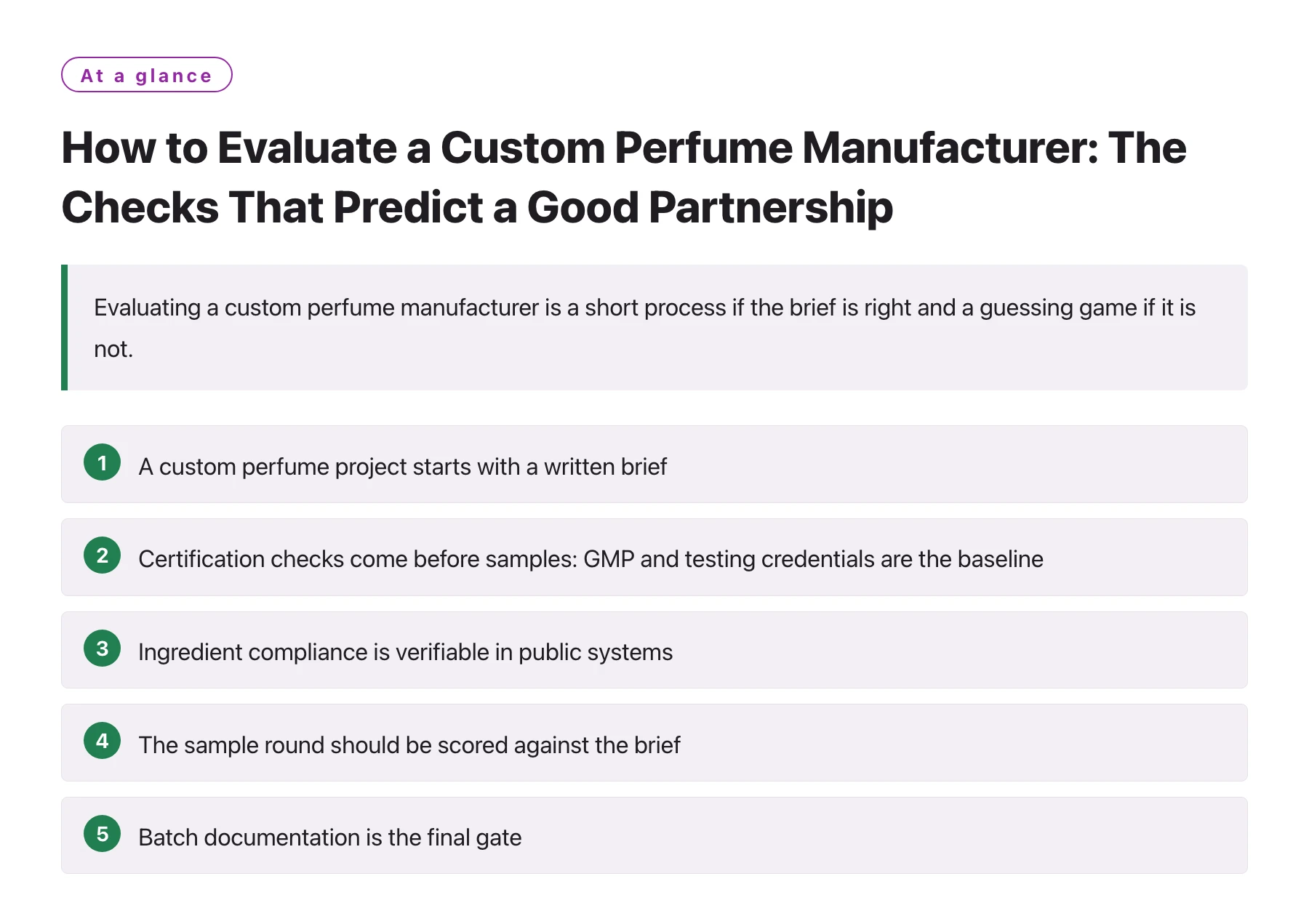
Key takeaways
- A custom perfume project starts with a written brief; every evaluation step after it depends on the brief being specific enough to score.
- Certification checks come before samples: GMP and testing credentials are the baseline, and third-party testing services exist precisely to verify them [1].
- Ingredient compliance is verifiable in public systems, from IFRA's standards library to the EU ingredient database [2] [3].
- The sample round should be scored against the brief, not against intuition, with the same criteria for every supplier.
- Batch documentation is the final gate, because it is the only evidence that the approved sample can be repeated at volume.
The word custom means different things to different factories, and the evaluation starts when the brand forces a definition. This article gives the four-stage sequence and the scorecard behind it, written for a beauty brand that already knows its market and needs a manufacturer that can deliver a specific scent, which is the kind of brief a custom perfume factory exists to answer.
Stage one: the written brief comes first
A vague brief produces samples that are hard to compare. The useful brief fixes the scent family, the format (spray, solid, oil), the concentration class, the target price band, the packaging direction and the destination markets. Every manufacturer receives the same one-page document, and the evaluation is run against it, not against what the suppliers happened to send.
A manufacturer that asks sharp questions back, about dosage, stability expectations and claim support, is demonstrating the behaviour the brand actually needs. A manufacturer that only confirms the brief and quotes is answering the samples question, not the partnership question.
What makes a brief scoreable
Scoreable means every line of the brief maps to a checkable output: the scent family maps to the sample, the format maps to the packaging sample, the price band maps to the quotation, and the markets map to the documentation. If a line of the brief cannot be scored, it will not be met either.
The certification baseline
Before samples, verify the facility's quality credentials. Cosmetics GMP frameworks such as ISO 22716 are the operational baseline for repeatable production, and independent testing organisations built their cosmetics audit and testing services around exactly those standards, so a third-party check is affordable and routine [1].
The supplier scorecard
| Check | Where to look | Red flag |
|---|---|---|
| Written brief quality | How the supplier responds to your one-page brief | Confirms everything, asks nothing |
| Certifications | GMP, ISO management systems, and the certificates' scope | Certificates listed but no scope or issue date |
| Ingredient compliance | IFRA standards library and public ingredient databases | Cannot show which standards apply to the formula |
| Sample round | Scored against the brief across all suppliers | Samples arrive without a scent profile or dosage note |
| In-house scope | Which production steps the factory does itself | Filling and testing outsourced, but priced as in-house |
| Batch documentation | One real batch record, walk it through | Records exist only in the commercial department |
| Communication discipline | Response time and revision tracking during sampling | Decisions delivered verbally, nothing in writing |
Treat the scorecard as a filter, not a beauty contest: a supplier that fails the certification or documentation rows is out regardless of how good the sample smells.
Stage two: verify the compliance systems
Compliance in fragrance is verifiable in public: IFRA publishes the standards that govern fragrance materials, national and regional bodies publish their ingredient databases, and a serious supplier can point to which parts of that system apply to your formula [2] [3]. The test is not whether the supplier has heard of these systems; it is whether they can name the ones that apply to your markets and your formula.
The same verification applies to the ingredient list itself. A manufacturer should be able to walk the brand through the composition, the restricted materials and the safety assessment route for the finished product, because that walk-through is the same one the destination market's authority will eventually ask the brand to reproduce.
Stage three: the scored sample round
Score every sample against the brief on the same five criteria, such as scent fit, performance, stability behaviour, presentation and documentation. Blind-scored rounds are worth the extra effort, because the brand's own expectation of a familiar supplier is the largest source of bias in the whole evaluation.
Stage four: the batch record walk-through
The final gate is one real batch record, walked from raw material intake to release. If the record is coherent, the milestones are dated, and the controls match the sample, the supplier can probably repeat the approved product at volume. If the record lives only in the sales office, the sample has passed but the process has not.
The evaluation is four stages, and the temptation is always to skip the first and jump to the samples. Every skipped stage reappears later as a reformulated scent, a missed market document or a batch that cannot be repeated, and each of those costs more than the stage did.
Shortlist, then pilot
Run the scorecard on three or four candidates, shortlist two, and put the winner through a pilot order before committing to a range. The pilot is the only test that combines the sample, the documentation, the lead time and the communication discipline in one real transaction, and it is the same routine a contract manufacturer for perfume brands runs for every new client.
Manufacturers with long export experience usually make the pilot easy to run because they have done it hundreds of times; a Chinese manufacturer with years of export work builds its reputation on that repeatable pilot experience, which is why the research phase for the buyer is mostly about checking the claims rather than making them up.
Sources
- SGS: Cosmetics, Personal Care & Household Testing —— Testing, inspection and certification services for cosmetics and personal care, including microbiological, stability and safety testing aligned with cosmetics GMP.
- IFRA Standards Library (International Fragrance Association) —— The IFRA Standards Library lists the restrictions the fragrance industry applies to individual fragrance ingredients, based on safety assessments; it is the reference point for compliant fragrance formulation.
- EU CosIng — Cosmetic Ingredient Database (European Commission) —— The European Commission's CosIng database of cosmetic ingredients, listing ingredient functions, restrictions and labelling requirements under EU cosmetics law.
Frequently asked questions
How many suppliers should we evaluate before choosing a custom perfume manufacturer?
Three or four candidates is enough to see the range of answers the market gives to the same brief, and shortlisting to two before a pilot keeps the comparison manageable. The written brief and the scorecard matter more than the number of candidates.
What certifications should a custom perfume manufacturer hold?
As a baseline, cosmetics GMP (such as ISO 22716) plus relevant ISO management systems, with the certificate's scope and issue date verified independently. Think of certifications as the entry ticket to the conversation, not the proof of quality.
How do I check a supplier's ingredient compliance claims?
Ask which IFRA standards and which regional ingredient databases apply to your formula, then verify against the public systems yourself. The supplier's ability to name the applicable rules is the test; your own check is the confirmation.
What is the fastest way to fail an evaluation?
Skipping the written brief. Without a fixed brief, samples are incomparable, quotes are unreadable and the scorecard has nothing to score. The evaluation speed actually comes from the one page both sides agree on first.
Should the pilot be a real product or a test batch?
A real product, sold into the market if possible, because that exercises the documentation and the shipping as well as the formula. A test batch proves the factory can make the scent; only a real order proves the factory can make the business work.
A free thirty-minute discovery consultation, in-studio or by call, opens every project.