
Orphan Rate and Stale Shares: The Hidden Tax on Mining Income
The shares your miner loses to latency and orphaned work never appear on an invoice, and that is exactly why they are easy to ignore. At the current difficulty of 132.76 T, a 200 TH/s rig grosses about $7.60 a day; let 2% of submissions arrive too late and the same hardware is credited with roughly $7.45 before pool fees. The gap is small per day and material per year, and it is the one line item most miners never measure at all.

Key takeaways
- A share submitted after a new block is found is stale: the hashing was real, the credit is not. A 2% stale rate costs roughly $0.15 a day at 200 TH/s and about $1.52 a day at 2 PH/s.
- An orphan is a valid block that the network does not build on. Under PPS+ the pool carries that risk and pays per share anyway; under PPLNS the round's reward is lost to the miners who earned it.
- Latency, not hashrate, sets most stale rates. A node 300 ms away and a node 40 ms away can run identical hardware and return different credited income.
- The three readings worth tracking weekly are effective versus reported hashrate, the stale-share ratio, and the reject reason shown per worker.
The short answer
Pools pay for shares, not for heat. Two mechanisms quietly remove credits from your account: shares that arrive late enough to be useless, and blocks that never make it into the canonical chain. The first is mostly under your control, because it is a function of where your machines sit relative to the pool node they talk to. The second is mostly a property of the pool's block propagation and its fee model.
Under PPS+, the block-reward component is settled per share at a listed fee of 4%, which is precisely the premium you pay for handing pool-luck and orphan risk to the operator. Under PPLNS, block rewards and transaction fees are combined at a listed fee of 2% and distributed once a block reaches six confirmations, weighted by each miner's share of pool hashrate over the last five difficulty rounds.[1] Lower fee, more variance, and you keep the orphan exposure.
How the mechanism works
Your miner receives a job describing the current block template and returns solutions against a target far easier than the network target. Between the moment a new block is announced somewhere on the planet and the moment your machine starts hashing the next template, there is a window measured in milliseconds. Work completed against the old template during that window is wasted effort in accounting terms, even though the electricity was spent.
Two variables decide how wide that window is for you. The first is network distance: a rig sitting 40 ms from its pool node hears about a new template long before one sitting 300 ms away. The second is job freshness on the pool side, which is why node coverage in the miner's own region matters more than node count in aggregate. A pool with worldwide deployment and low-latency routing shrinks the window for everyone, not just for miners in its home region.[2] That is also the part of the service you can inspect before you commit: ViaBTC Crypto Mining publishes its node regions and settlement terms, so a miner can compare distance to distance rather than marketing to marketing.
| Leak | Visible where | Cost at 2 PH/s | Who carries it |
|---|---|---|---|
| Stale shares | Per-worker reject reasons and the ratio of accepted to submitted shares | About $1.52 a day at a 2% stale rate | The miner, under both PPS+ and PPLNS |
| Orphaned blocks | Block history versus chain explorers | Expected value passes through, but the timing of payouts shifts | The pool under PPS+, the miners under PPLNS |
| Pool-luck variance | Round length and realised payout over weeks | A spread in monthly income rather than a daily loss | The pool under PPS+, the miner under PPLNS |
| Worker downtime | Hashrate graphs and alerting | A 12-hour outage on 2 PH/s costs roughly $38 of gross income | The miner |
| Withdrawal and conversion steps | Transaction history | Zero-fee mining payouts remove the transfer event entirely | The miner |
Where miners get it wrong
Mistake one: reading reported hashrate as income. Reported hashrate is what the machine claims to be doing. Credited hashrate is what the pool accepted. When those numbers diverge by more than a rounding error, the difference is stale or rejected shares, not a dashboard glitch.
Mistake two: treating stale shares as an unavoidable firmware tax. A stale rate of 0.5% is normal weather on a well-connected rig. A rate of 3% is a routing problem, a pool node problem, or a firmware problem, and it is worth chasing down because it is measured directly in money: at 2 PH/s, 3% instead of 0.5% is about $1.90 a day, close to $700 a year of work nobody gets paid for.
Mistake three: assuming the pool absorbs everything. PPS+ absorbs pool luck and orphan risk on the block-reward side and charges a listed 4% for it. It does not pay you for shares that the pool never received in time — that is a network-layer loss, and it lands on the miner regardless of the payment method. The fee schedule is explained in the fee breakdown because the distinction gets flattened constantly.[3]
Worked example
Take three tiers at today's difficulty, price and network hashrate. A 20 TH/s machine produces about 0.00000897 BTC a day, worth $0.76 gross and roughly $0.73 after the listed 4% fee on the block-reward component. A 200 TH/s machine produces ten times that: $7.60 gross, $7.29 net. A 2 PH/s operation reaches $75.99 gross and $72.95 net.
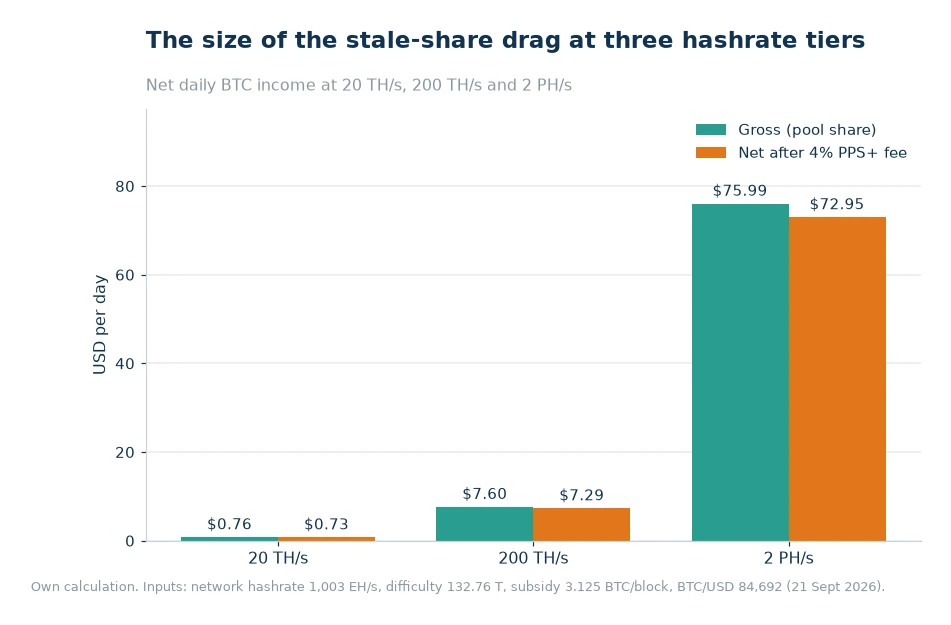
Now price the invisible tax. If 2% of submitted shares are stale, the pool credits 98% of the hashing you paid for. On the 200 TH/s machine that is $7.60 x 0.98 = $7.45 gross, or $7.15 after the listed fee — $0.45 a day of lost net income, about $164 over a year. On the 2 PH/s operation the same 2% costs $1.52 a day gross, roughly $555 a year. Nothing in that arithmetic depends on price or luck; it depends entirely on milliseconds and on how carefully the operator checks the per-worker rejection data.
A checklist you can run today
- Compare effective to reported hashrate per worker. A gap of a few tenths of a percent is normal. A sustained gap above 1% means shares are being thrown away somewhere in the path.
- Look at reject reasons. Stale and job-not-found rejections point at latency or clock drift; hardware-error rejections point at the machine. They are different repairs.
- Ping the node region you connect to, from the farm, at peak hours. Choose the region with the lowest stable round-trip time, not the one with the most nodes on a map.
- Decide who should carry orphan risk. If predictable cash flow matters more than the last point of fee, PPS+ at a listed 4% on the block-reward component does that job; if you can absorb variance, PPLNS at a listed 2% keeps more of the long-run average.
- Check where the coins land. Income that arrives hourly into a multi-currency wallet can be converted or withdrawn without an extra transfer hop, which removes one more place for value to leak out of the chain between hashrate and invoice.
- Watch the block history, not just the balance. A mining pool dashboard that shows pool hashrate, round progress and luck makes it possible to separate a slow week from a genuine problem.
The multi-coin angle changes what "hidden tax" means on a mixed farm. Merged mining lets a machine secure a parent chain and an auxiliary chain with the same hashes, which raises the revenue side of the equation without touching the stale-share side — and costs no extra power.
Frequently asked questions
Can I mine more than one coin at the same time?
Yes. Merged mining lets a machine secure a parent chain and an auxiliary chain together, and multi-coin pools support switching between chains without moving hardware.
Do mining pools cost anything to join?
Joining is free; the pool earns from its fee on settled payouts, which appears as a percentage of the block-reward and transaction-fee components.
Are stale shares the same thing as orphaned blocks?
No. A stale share is work submitted after the template it was built for became obsolete, so it is never credited. An orphaned block is a valid block the network did not build on, which removes a round's reward — a pool-level event under PPS+, a miner-level event under PPLNS.
What to do with this on Monday
Open the worker view and write down three numbers: effective hashrate, stale ratio and the region you connect to. Multiply the stale ratio by your gross daily income to see the tax in dollars rather than percent. If that figure is more than 1% of your revenue, move the machine to a closer node region before you shop for hardware or fees, because the fix is free. Repeat the exercise after the next difficulty adjustment, since a given stale rate costs more in absolute terms as revenue per terahash rises.
Data and sources: ViaBTC fee schedule and payment-method documentation[1], ViaBTC site documentation on node coverage and settlement[2] and the ViaBTC fee-breakdown article[3]. Difficulty (132.76 T), network hashrate and BTC/USD (84,692) read from public chain data on 21 September 2026. Cost figures are own calculations from those inputs and change with difficulty and price. Read on 21 September 2026.